BLOG / SEO & AI SEARCH · 24 October 2026
SEO Is No Longer Enough: How AI Search and GEO Are Changing Brand Visibility
Discover how SEO, AI Search and GEO influence brand visibility, and learn five practical ways to improve your business's online discoverability.
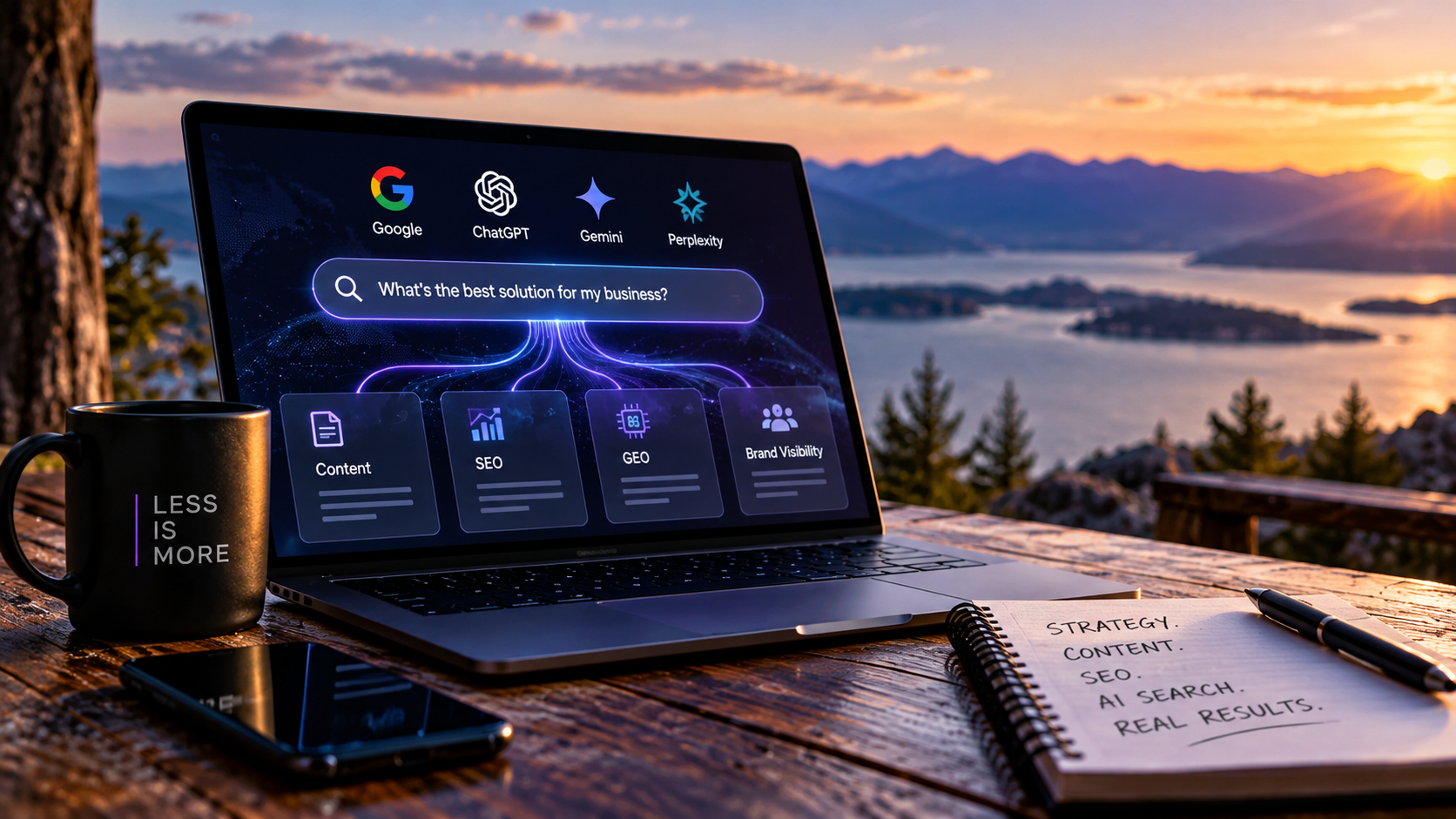
For years, businesses have invested in SEO to appear on Google's first page. They researched keywords, optimized websites, published articles, and worked to attract organic traffic.
That still matters. But the way people discover businesses is changing.
Instead of searching for a list of websites, potential customers increasingly ask AI tools to compare solutions, explain services, and recommend providers.
The important question is no longer just whether your business appears in search results.
It's whether your business is visible when AI helps someone make a decision.
From search results to AI-generated answers
Consider a company looking for an IT service provider.
A traditional Google search might be:
"IT infrastructure management services"
An AI-powered search might look very different:
"Which IT infrastructure management solutions are suitable for a company with 500 employees, and how do they compare in terms of cost, security, and scalability?"
The second query reveals much more about the buyer's needs.
AI systems can bring together information from multiple sources and provide a structured answer, sometimes including links to supporting websites.
For businesses, this creates another opportunity to be discovered. It also introduces a challenge: having a website does not automatically mean your company will be mentioned or recommended.
SEO, AEO and GEO: What's the difference?
These terms are closely connected, but they describe different areas of focus.
SEO — Search Engine Optimization
SEO improves a website's ability to be discovered through search engines. It includes technical performance, content relevance, site structure, internal linking, and authority.
AEO — Answer Engine Optimization
AEO focuses on making information useful for systems that provide direct answers to questions. Clear explanations, accurate information, and well-organized content are important here.
GEO — Generative Engine Optimization
GEO describes efforts to improve how a brand or its content is represented, discovered, or referenced in AI-generated responses.
These are not three completely separate marketing disciplines.
In fact, Google considers traditional SEO fundamentals essential to visibility in its generative search features.
The practical approach is to build on strong SEO rather than abandon it for a new acronym.
Why good content matters more than ever
Publishing more articles is not automatically a growth strategy.
A company might produce twenty generic blog posts about industry trends and still fail to answer the questions its potential customers are asking.
Compare these two topics:
"Benefits of IT Management"
and
"How to Reduce IT Support Costs Across 500 Employee Devices Without Replacing Existing Hardware"
The second topic addresses a more specific business problem.
It provides opportunities to discuss costs, operational risks, practical solutions, and measurable outcomes.
That makes it more useful to a potential buyer, whether they discover it through Google, LinkedIn, or an AI-powered search tool.
Content should demonstrate expertise, not simply repeat information that already exists across hundreds of websites.
Five practical steps to improve AI search visibility
1. Answer real customer questions
Start with the questions your sales team, customers, and prospects repeatedly ask.
Develop articles that provide clear, accurate, and useful answers.
For example, a cybersecurity provider could explain how a medium-sized business should evaluate endpoint protection solutions, including limitations and implementation considerations.
2. Demonstrate experience and credibility
Publish original insights, practical examples, case studies, and evidence that supports your recommendations.
If your company has solved a specific problem, explain the approach and results without exaggerating them.
Original expertise gives readers a reason to trust your content and can make it more useful as a reference.
3. Keep your technical SEO healthy
Make sure important pages can be crawled and indexed, load properly on mobile devices, and contain accessible text.
Use clear headings, descriptive page titles, internal links, and appropriate structured data where relevant.
There is no special markup that guarantees inclusion in Google's AI-generated answers.
4. Build a consistent brand presence
Your website should not operate in isolation.
Maintain accurate information across relevant professional profiles, industry publications, business listings, and other channels where your audience researches solutions.
For B2B companies, LinkedIn can also help distribute expert content and create opportunities for professional discussion.
The objective is genuine credibility, not artificial mentions or manufactured authority.
5. Measure more than website traffic
Organic sessions and keyword rankings remain useful, but they do not tell the whole story.
Monitor branded searches, qualified leads, conversions, referral traffic, and the questions that bring relevant visitors to your website.
Where reliable reporting is available, examine visibility in AI search experiences as well.
You can also test representative buyer questions in AI tools to understand how your category and competitors are described. Treat these observations as directional research, not guaranteed rankings.
What this means for small and medium-sized businesses
You do not necessarily need a large marketing department or an expensive publishing schedule to start adapting.
A smaller company with clear positioning, useful expertise, and well-maintained content can compete for relevant attention.
Start with a focused content audit.
Identify the services that matter most to your business, the questions customers ask before buying, and the information your website currently fails to provide.
Then prioritize improvements that support both human visitors and search discovery.
The objective is not to publish for algorithms.
It is to become a credible, useful source of information for the people who may eventually become your customers.
The future of visibility is broader than rankings
SEO is not disappearing. Its role is expanding as search experiences evolve.
Businesses should continue investing in discoverable websites, useful content, technical quality, and credible brand communication.
AI search introduces additional ways for people to encounter that information, but it does not remove the need for strong marketing fundamentals.
The goal is not simply to be found. It is worth finding.
Want to improve how your business is discovered through search, content, and AI-powered platforms?
At Less Is More, we connect content strategy, SEO, AI search visibility, and organic growth around practical business objectives.
Less noise. More impact.
MONTHLY NEWSLETTER
Less inbox noise. More useful marketing.
One useful email a month with practical updates from social media, content marketing, SEO, AI search and digital marketing.
- No daily promotions.
- No endless sales emails.
- Only changes, ideas and tools worth knowing about.
RELATED ARTICLES
How Much Does a Business Website Cost and What Are You Actually Paying For?
What the €249 starting package includes, which optional services make sense and how to separate development from domain, hosting and maintenance costs.

More posts won’t fix your marketing: what I’ve learned from over 10 years of working in social media
Most brands don’t have a problem with the amount of content they produce. They have a problem with relevance.

LinkedIn Organic Growth for B2B: Why Visibility Without Engagement Means Nothing
For B2B companies, visibility alone is not a strategy. Reach the right people and give them a reason to remember your business.